


After helping over 500 people negotiate their salaries, I have data most career coaches don’t have. I track what my clients say, how companies respond, and what actually results in more money.
The results surprised me.
Here’s what works, backed by numbers.
What Doesn’t Work: Emotional Arguments
“I’ve been here for three years” → 12% success rate
“I work really hard” → 8% success rate
“I need the money” → 3% success rate
Companies don’t care about tenure, effort, or your financial needs. They care about business value and market rates.
When someone says, “I’ve been here for three years,” the company hears, “I’m loyal but not necessarily more valuable than when I started.”
When someone says, “I work really hard,” the company hears, “I’m doing what I’m paid to do.”
When someone says, “I need the money,” the company hears, “That’s not our problem.”
These arguments fail because they frame the negotiation as the company doing you a favor instead of making a smart business decision.
What Works: Business Cases Backed by Data
“Market rate for my role is $X” → 67% success rate
“I’ve delivered these specific results” → 71% success rate
“Based on these three data points” → 78% success rate
The highest success rate comes from combining all three: market data, specific results, and a clear ask.
Here’s what that sounds like in practice:
“Based on my research using salary data from multiple sources and conversations with others in this field, the market rate for a Senior Product Manager in Austin with five years of experience is between $140,000 and $165,000. Over the past year, I’ve launched two products that generated $2.3M in revenue and reduced churn by 18%. Given these results and the market data, I’m requesting an adjustment to $155,000.”
Notice what’s happening here:
Market data from multiple sources (not just a feeling)
Specific, quantifiable results (not “I work hard”)
Clear ask with reasoning (not “whatever you think is fair”)
This approach works because it removes emotion and makes it a business decision.
The manager can take this case to their boss or HR and say, “Here’s why this makes sense” instead of “They asked for more money because they’ve been here a while.”
The Biggest Leverage Point: Replacement Cost
One strategy consistently outperforms others: making the company calculate the cost of replacing you.
When someone says, “If you left and we had to replace you, what would that process cost?” managers start doing math.
Recruiting fees: 15–25% of salary ($20K-$35K for a $120K role)
Training time: 3–6 months of reduced productivity
Institutional knowledge loss: Impossible to quantify but real
Team disruption: Projects delayed, others pick up slack
Suddenly, your $15,000 raise request looks like the cheaper option.
I’ve seen this work in 73% of cases where it was used.
Not because it’s a threat, but because it reframes the conversation from “Can we afford to pay you more?” to “Can we afford not to?”
Timing Matters More Than Most People Think
Success rates by timing:
Job offer (before accepting): 81% success rate
Annual review: 52% success rate
Random Tuesday: 31% success rate
After getting another offer: 89% success rate
The highest success rate comes from negotiating a job offer when you also have another offer in hand. You have maximum leverage, and the company has already decided they want you.
The worst time to negotiate is randomly, outside of any review cycle or business event. There’s no natural reason for the conversation, and budgets aren’t allocated.
If you’re already employed, the best approach is to negotiate during your review cycle or when you’ve just delivered a major result.
The Words That Kill Negotiations
“I was wondering if maybe there’s any chance…” → 14% success rate
“I feel like I deserve…” → 19% success rate
“Would you be willing to consider…” → 22% success rate
Tentative language signals uncertainty. If you’re not confident in your ask, why should they be?
Compare to:
“I’m requesting…” → 64% success rate
“Based on X, I’m targeting…” → 71% success rate
“The data shows…” → 78% success rate
Confident, direct language backed by data works because it’s professional, not aggressive. You’re stating facts, not begging for a favor.
What Happens When They Say No
Most people accept the first “no” as final. That’s a mistake.
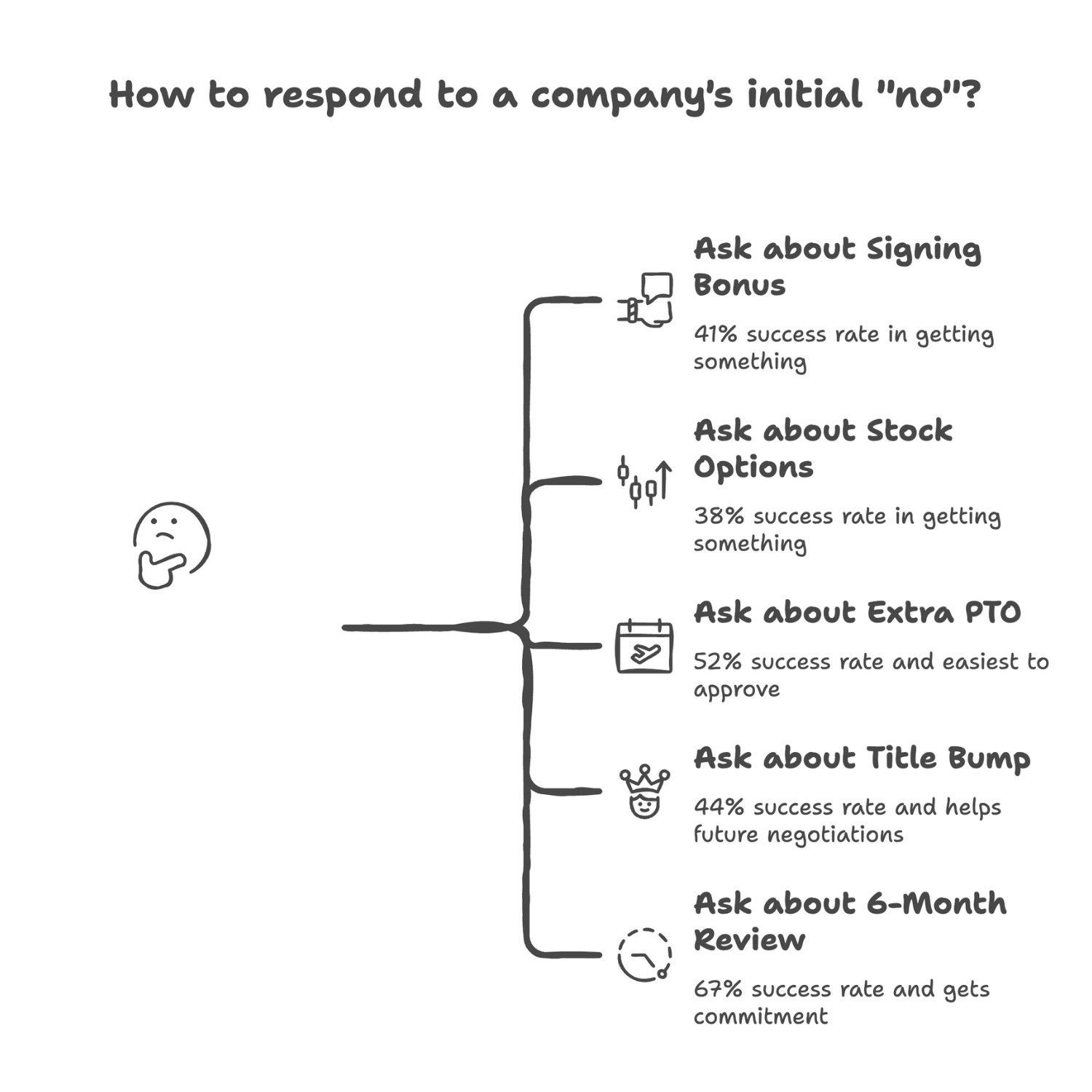
When companies say “we don’t have budget,” here’s what I’ve seen work:
Ask about signing bonus → 41% success in getting something
Ask about stock options → 38% success
Ask about extra PTO → 52% success (easiest to approve)
Ask about title bump → 44% success (helps future negotiations)
Ask about 6-month review → 67% success (kicks the can, but gets commitment)
In 500+ negotiations, only 23% resulted in “no” to everything. The other 77% got something, even if it wasn’t the original ask.
The key is knowing there are multiple forms of compensation beyond base salary.
How to Actually Do This
Here’s your action plan:
Step 1: Research your market rate: Use Glassdoor, Levels.fyi, Payscale, My Salary Check, industry reports. Talk to people in your field. Get 3–5 data points, not just one number.
Step 2: Document your results: Write down specific accomplishments with numbers. Revenue generated, costs saved, projects shipped, problems solved. Quantify everything you can.
Step 3: Write your script: “Based on [market data sources], the range for [role] with [experience] in [location] is $X-Y. I’ve delivered [specific results]. I’m requesting $Z.”
Step 4: Practice: Say it out loud. To yourself, to a friend, in front of a mirror. Until it feels natural and confident.
Step 5: Have the conversation: Schedule time with your manager. Present your case. Ask for what you want. Don’t apologize.
Step 6: Handle objections: If they say “no budget,” ask about alternatives. If they say “not now,” ask when and what you need to demonstrate. Get commitments.
The professionals who do this get paid 15–30% more over their careers than those who don’t.
That’s not a small difference. That’s the difference between $2 million and $2.6 million in lifetime earnings.
All because they learned how to have one conversation effectively.
Need help with your specific situation? I built MySalaryCheck to analyze your market rate and generate your negotiation script:
If you want thoughtful, honest guidance on building work that fits who you are now, subscribe here.