


Earlier this week, I left a comment on LinkedIn that I didn’t think much about.
It wasn’t a carefully written one. Neither was it a part of a content strategy. It was simply an observation I’ve made after years of speaking with professionals navigating layoffs.
A few days later, I noticed it had been viewed more than 25,000 times!
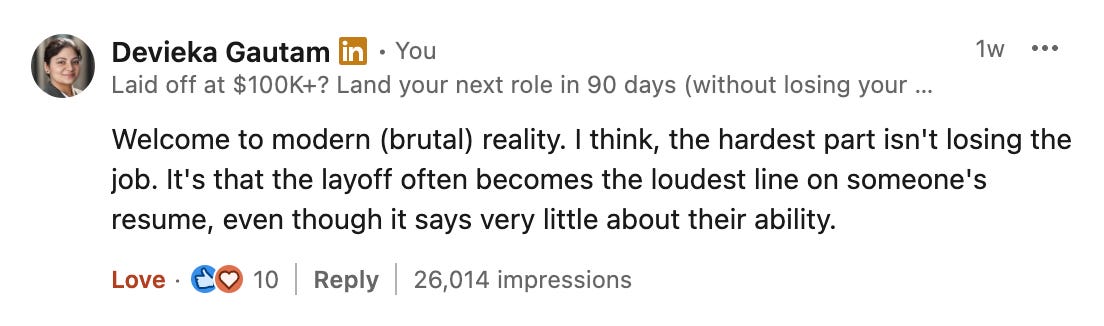
The comment read:
“Welcome to modern (brutal) reality. I think the hardest part isn’t losing the job. It’s that the layoff often becomes the loudest line on someone’s resume, even though it says very little about their ability.”
As I read through the replies, something struck me.
People weren’t really responding to the resume part. They were responding to what came before it.
“The hardest part isn’t losing the job.”
That sentence seemed to resonate because many people know exactly what comes next.
The uncertainty.
The awkward conversations.
The silence after sending applications.
The quiet question that begins to creep into your mind: What if this says something about me?
I’ve heard that question in different forms over the years.
“Maybe I’m not as valuable as I thought.”
“Maybe my skills aren’t relevant anymore.”
“Maybe this happened because I wasn’t good enough.”
But interestingly enough, none of those thoughts appear in a termination letter. We write them ourselves.
That’s why I’ve come to believe that a layoff creates 2 challenges.
The first is practical: You have to figure out finances, update your resume, reconnect with your network, and start looking for opportunities.
The second is psychological: You have to stop this one business decision from becoming your identity.
The second challenge is often harder. Understandably so.
Companies don’t lay people off because everyone suddenly became bad at their jobs. They lay people off because markets change, budgets shrink, strategies shift, acquisitions happen, or leadership decides to move in a different direction. Sometimes entire departments disappear overnight. Sometimes the highest-paid people are let go simply because reducing payroll solves a financial problem.
Those decisions can change your employment status, but they don’t erase your work experience.
Yet it’s remarkable how quickly many accomplished professionals begin rewriting the story of their own careers.
20 years of solving problems suddenly feels less important than one difficult afternoon.
Years of leading teams become overshadowed by one meeting with HR.
An impressive career gets reduced to a single line: Laid off.
That’s the part that bothers me.
Not because layoffs aren’t painful. They are. I have gone through it myself.
But because they often become the lens through which people start viewing everything else they’ve accomplished.
When that happens, it shows up in subtle ways.
People begin apologizing for things they never controlled.
They spend interviews explaining why they left instead of showing why they should be hired.
They rewrite their resumes over and over again, hoping a different summary or a stronger bullet point will somehow restore the confidence they’ve lost.
In reality, confidence rarely returns because of a better resume.
Your confidence returns when you remember that your career is much bigger than the company that happened to employ you last.
A resume is simply a snapshot, but your career is the story.
Don’t confuse the two.
This weekend, I’d like you to try something before you update another bullet point or submit another application.
Open a blank document and answer this question:
“If the layoff had never happened, how would I describe my career?”
Write whatever comes to mind.
Don’t mention the layoff.
Don’t mention the job search.
Write about the problems you’ve solved, the people you’ve helped, the decisions you’ve made, and the moments that made you proud.
When you finish reading it, ask yourself one more question.
“Is this the person I’m showing employers today?”
If the answer is no, don’t start by changing your resume.
Start by changing the story you’ve been telling yourself.
Because employers don’t hire your layoff.
They hire your experience, your judgment, and your ability to solve problems.
Those things didn’t disappear the day your role did.
Your Turn
This week’s prompt is designed to help you separate what happened to you from what is true about you.
Copy and paste it into your favorite AI assistant.
“I was recently laid off, and I think it’s affecting how I see myself professionally.
Don’t rewrite my resume.
Instead, help me rebuild my professional confidence.
Ask me questions about the work I’m most proud of, the biggest problems I’ve solved, the people I’ve influenced, and the achievements that mattered most throughout my career.
Then identify any limiting beliefs I’m carrying because of the layoff.
Challenge those beliefs using evidence from my own experiences.
Finally, help me write a short professional narrative that reflects my strengths, values, and direction without letting the layoff define my career.”
This Week’s Conversation
Earlier this week, I offered a few free resume teardowns for professionals who have been applying for more than 60 days without getting interviews.
Reading through the responses reminded me that many talented people aren’t struggling because they lack experience. They’re struggling because they’ve spent months trying to fix the document instead of clarifying the story behind it.
If that sounds familiar, I’d love for you to join the conversation.
→ Read the LinkedIn discussion
Thank you for reading.
I’ll see you next Saturday.
Devieka
Every Saturday, I write about the patterns I’m noticing across layoffs, hiring, career positioning, and job searches, then share one actionable prompt to help you think through your own career.