


A few weeks ago, a client told me something I haven’t stopped thinking about.
She had spent more than 11 years building her career and had recently been laid off from a VP-level role.
When I asked her how she was introducing herself during networking conversations, she paused.
Then she said:
“I keep introducing myself by what I used to be. Like I’m reading from an old business card.”
I understood exactly what she meant.
Because a layoff doesn’t just remove your paycheck.
It removes the context that made your professional identity feel obvious.
Your title disappears.
Your company email stops working.
Your team moves on.
And suddenly, something that felt permanent for years is no longer yours.
That’s when a strange question can start creeping in:
“Who am I without that job?”
I’ve heard versions of that question many times.
And I think there’s an important distinction we often miss.
Your title is not your career. It’s simply the label your last company gave you.
Think about what actually made you valuable in that role. It probably wasn’t the words on your LinkedIn profile.
It was the decisions you made.
The problems you solved.
The people you influenced.
The mistakes you learned from.
The relationships you built.
The judgment you developed after doing the work for years.
Those things don’t disappear when your employment ends. In fact, they’re often the most valuable things you take with you.
But there’s a problem.
Most people don’t know how to describe them without their old title doing the work for them.
“VP of Operations” tells someone what level you had reached. It doesn’t necessarily tell them what you are exceptionally good at.
“Senior Product Manager” tells someone what your function was. It doesn’t tell them which problems you know how to solve better than most people.
“Director of Marketing” tells someone where you once sat on the org chart. It doesn’t tell them what changed because you were there.
That’s the gap I see in many post-layoff job searches.
People lose the title, then immediately try to replace it with another title. They start searching for:
VP of Operations.
Director of Strategy.
Head of Customer Success.
But the better question isn’t “What title should I have next?”
It’s “What value do I want my next role to recognize?”
That question changes the search.
Because now you’re not starting with the job title. You’re starting with the evidence.
By evidence, I want you to think:
The project you turned around.
The team you built.
The revenue you influenced.
The process you improved.
The crisis you handled.
The decisions you made when there wasn’t an obvious answer.
That’s your career. The title was just the label attached to it.
And this matters because the first few weeks after a layoff can make you forget that distinction.
You start looking at job descriptions and asking whether you’re qualified. You compare yourself to people with better titles. You wonder whether employers will see you differently now.
You start treating the layoff as if it changed your professional value. But it didn’t. But it may have changed how clearly you can see it. That’s something worth fixing.
Not by immediately rewriting your resume. Not by applying to another 50 jobs. And not by trying to sound more impressive.
Start small.
This weekend, take 10 minutes and answer these 3 questions:
What are 3 problems I became unusually good at solving?
What are 3 results that happened because I was involved?
What are 3 things people consistently came to me for?
Don’t use your job description and don’t copy your resume. Make sure not to worry about making the answers sound impressive. Just tell the truth.
Then read your answers and ask yourself:
“If I removed my last job title, would I still recognize the professional described here?”
I hope the answer is yes.
Because if it isn’t, that’s where the work begins.
The real work would then lie in not rebuilding a title but rebuilding your understanding of the value underneath it.
Your Turn
This week’s prompt is designed to help you separate your professional identity from your last job title.
Copy and paste it into your favorite AI assistant (Claude, Gemini, ChatGPT)
“I was recently laid off, and I’m struggling to describe who I am professionally without relying on my previous job title.
Don’t rewrite my resume.
Instead, ask me questions about the problems I’ve solved, the results I’ve created, the decisions I’ve made, the people I’ve influenced, and the situations where others relied on my judgment.
Then identify the 3-5 strongest patterns in my experience.
Help me turn those patterns into a clear description of the professional value I bring, without using my previous job title as the main descriptor.
Finally, give me 3 possible directions for the kind of problems, roles, or environments where this value could be useful next.”
This Week’s Conversation
Earlier this week, I shared the story of a senior professional who had applied to 300 roles and received just 5 interview calls.
Her resume had been reviewed by recruiters who told her it was excellent.
But there was a problem.
One of her previous roles was genuinely Director-level in scope, but her official title made that seniority almost invisible to recruiters.
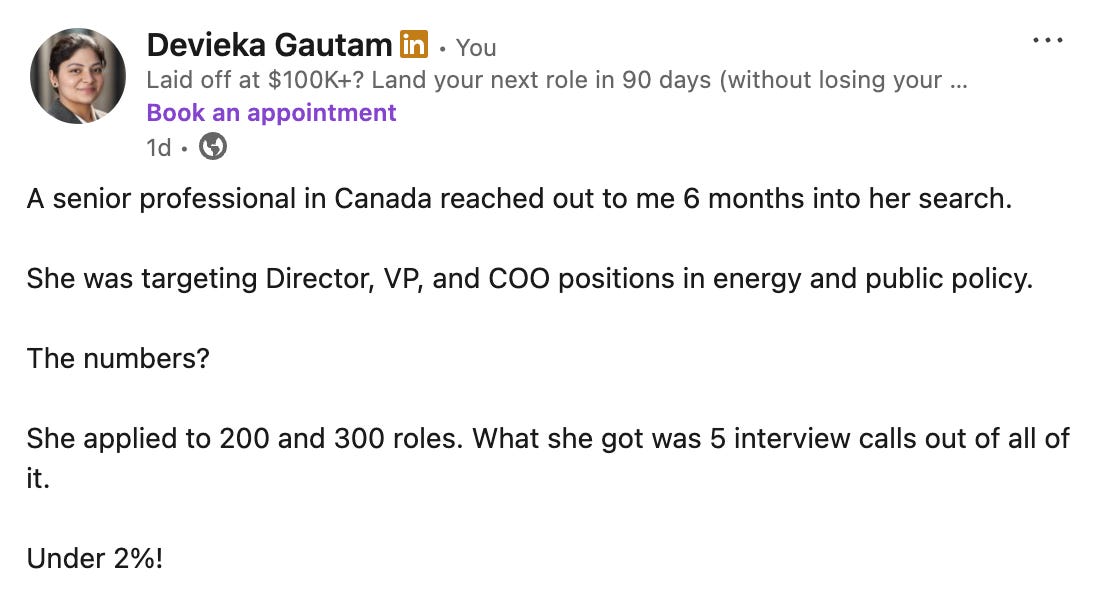
It was a good reminder that your title can be technically correct and still fail to communicate the level of work you’ve actually done.
I shared the full story, including what I found when I looked at her profile.
→ Read the LinkedIn discussion
And if you’re currently searching for a better job, ask yourself:
Does your LinkedIn profile communicate the level of work you’ve actually done, or just the titles you’ve held?
Thank you for reading.
I’ll see you next Saturday.
Devieka
Every Saturday, I write about the patterns I’m noticing across layoffs, hiring, career positioning, and job searches, then share one actionable prompt to help you think through your own career.
Great post! I didn't realize how much of my identity was wrapped up in my job title/professional life in general until I lost my job. It turned out to be the best thing that ever happened to me. I have no intention of jumping back into any full-time role, hopefully ever. I have decided that I am enough without a big title, and I am blessed to not have to go back to the corporate life unless I want to.