


Most people think they have a salary problem when what they actually have is a positioning problem.
They look at their paycheck, compare it to market data, and conclude they’re being underpaid. So they prepare for a negotiation, rehearse their talking points, and ask for more money.
Sometimes it works. Usually, it doesn’t change much. And even when it does, the number still feels wrong six months later.
The issue isn’t that you’re bad at negotiating.
The issue is that you’re negotiating from a weak position.
Compensation isn’t set by how hard you work or how good you are at your job. It’s set by how the market perceives your value. And market perception is driven almost entirely by positioning.
Positioning is how you’re categorized. It’s the box people put you in when they see your LinkedIn, read your resume, or hear you describe what you do.
If your positioning is vague, you get compared to a large pool of generalists. If your positioning is specific, you get compared to a smaller pool of specialists. The smaller the pool, the higher the leverage.
This is why two people with identical skills and experience can have wildly different earning potential. One is positioned as “a marketing manager.” The other is positioned as “the person who scales B2B SaaS companies from $10M to $50M ARR.”
Same skill set. Completely different market value.
The frustrating part is that most professionals never choose their positioning. They inherit it. Their job title becomes their identity. Their company’s description of their role becomes their description of themselves.
Then they wonder why the market undervalues them.
When your positioning is unclear, three things happen.
First, you attract the wrong opportunities. Recruiters reach out for roles that don’t fit. Hiring managers see you as interchangeable with dozens of other candidates. You end up competing on price instead of value.
Second, you lose negotiating power before the conversation starts. If the other side can’t clearly see what makes you different, they have no reason to pay a premium. You’re forced to justify your worth instead of having it be obvious.
Third, you undervalue yourself. When you can’t articulate your specific value, you start to doubt it. You accept offers that are “good enough.” You stop expecting more because you’re not sure you deserve it.
None of this is a character flaw. It’s a positioning failure.
The question isn’t “How do I get paid more for what I do?”
The question is “How do I make what I do unmistakably valuable to a specific market?”
Salary negotiations are downstream of positioning. If you fix the positioning, the compensation conversation gets easier. If you don’t, you’re just putting pressure on a system that was never designed to reward you.
Before your next compensation conversation, run your positioning through these three questions.
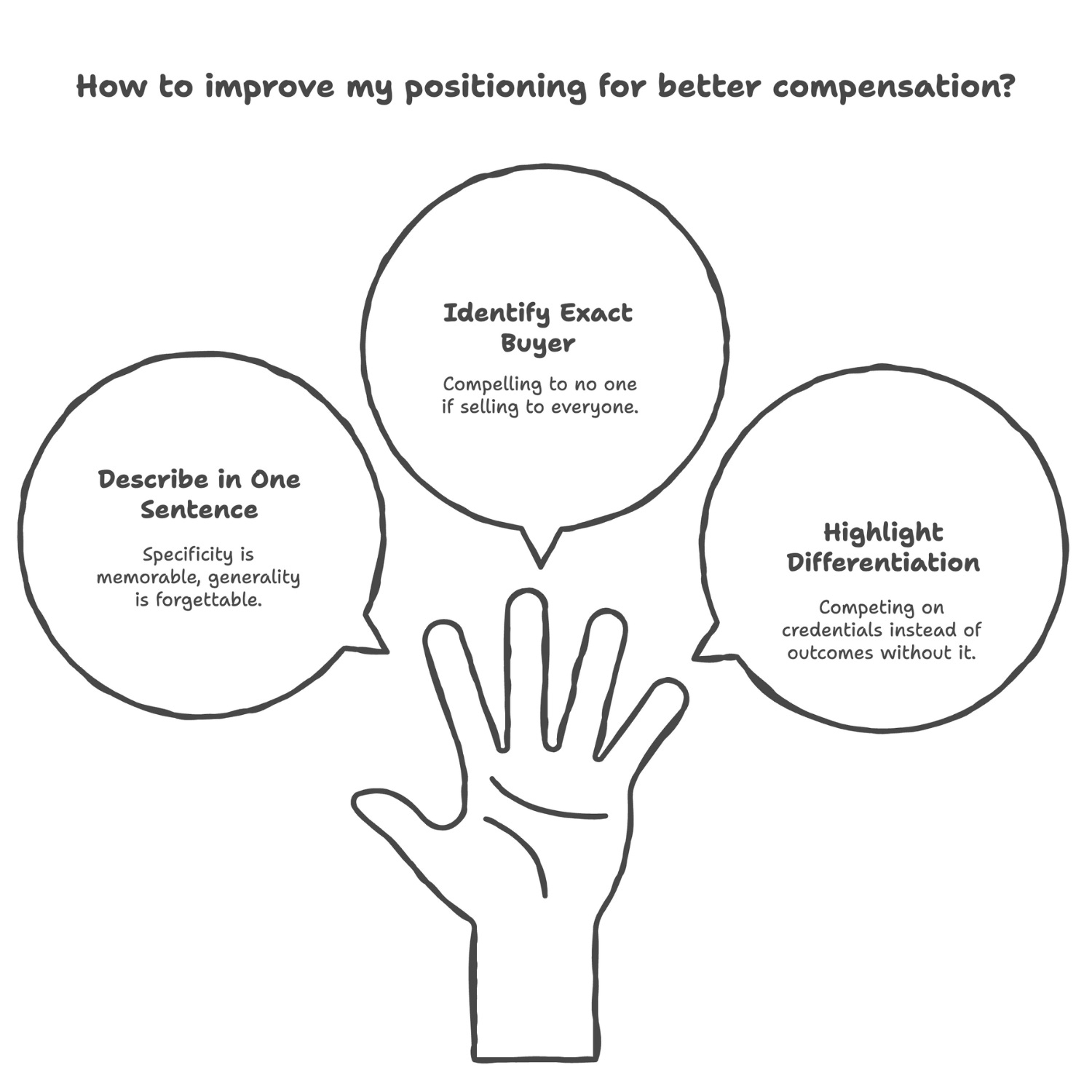
One: Can you describe what you do in one sentence that a stranger would remember?
If it takes a paragraph to explain your value, you’re under-positioned. Specificity is memorable. Generality is forgettable.
Two: Who is the exact buyer for your skill set?
Not “companies” or “hiring managers.” Which specific type of company, at which stage, with which problem? If you can’t name it, you’re selling to everyone, which means you’re compelling to no one.
Three: What do you solve that most people in your field don’t?
This is your differentiation. It’s not about being the best. It’s about being the obvious choice for a particular problem. If you can’t answer this, you’re competing on credentials instead of outcomes.
If you can answer all three clearly, you have positioning. If you can’t, that’s the work.
When your positioning is clear, the job search inverts.
Instead of applying and hoping, you get approached by people who already understand your value. Instead of negotiating from a defensive stance, you negotiate from a position of scarcity. Instead of wondering if you’re being paid fairly, you have a clear benchmark for what your positioning commands.
This doesn’t mean you’ll never face rejection or lowball offers. But it means you’ll stop questioning whether you’re worth more. You’ll know exactly what you’re worth, and to whom.
If your compensation feels stuck, don’t start with negotiation tactics. Start with positioning.
Figure out what you do, who you do it for, and why you’re the obvious choice. Get specific enough that a stranger could repeat it back to you.
The money follows clarity. It always has.
I hope this helped you.
See you next Wednesday,
Devieka
Here are 3 ways I can help you:
1. Check if you’re underpaid.
MySalaryCheck shows you what people in your role actually earn and gives you the exact words to say when negotiating. Takes 5 minutes.
2. Fix your personal brand.
BRANDxDASH optimizes your LinkedIn profile and resume so recruiters actually message you. Operating in 90+ countries.
3. Get weekly career advice.
I write about escaping the wrong career and building work that aligns. Subscribe to my newsletter.
Love love love this perspective!
Within six months of completing my doctorate, I was approached by a Senior Vice President of a Fortune 50 company. At our first meeting at his office he presented me with a redacted copy of a proposal submitted by a well known consultant in the industry. He asked me to evaluate it and return it with my comments within two weeks. (This was before the advent of the internet and online search capabilities). When I returned I presented him with my critique and evidence proving that 80 percent of the proposal was plagiarized. He asked if I could do what the consultant had proposed. My answer was, « No », because it was mostly fluff. He gave me a week to submit my own. I did, he accepted, and thus began a long and mutually beneficial relationship. All because I didn’t try to con the client.